


DEI Didn’t Die. It Was Targeted. And the Consequences Are Already Here.

Dr Sharon Washington June 4, 2026
Contents
Over the last year, a growing number of commentators have declared that “DEI is dead.”
Some have gone even further, celebrating its demise as a victory for merit, or as proof that institutions were never truly committed to equity in the first place.
I understand why some people feel that way.
In fact, many of the sharpest critiques of diversity, equity, and inclusion efforts have come from people who were deeply committed to racial justice in the first place. Many Black professionals, healthcare workers, educators, and organizers expressed concerns long before the current political backlash. They questioned whether organizations were truly committed to change or simply responding to public pressure. They worried that DEI had become more performative than transformational. They watched institutions issue statements, create committees, and hire DEI leaders without investing in the structural changes necessary to create meaningful equity.
Those concerns were valid.
But declaring that DEI is dead—and that this is somehow good news—misses a critical reality:
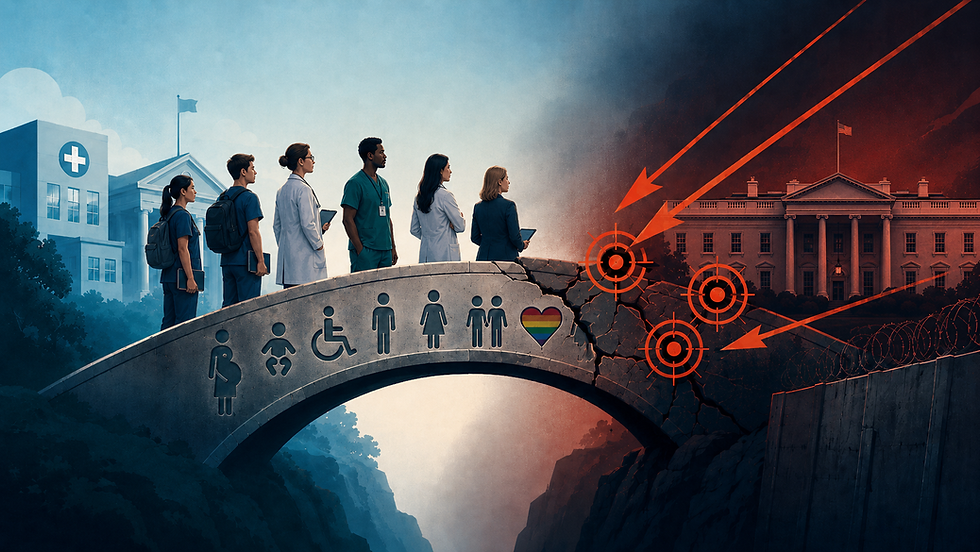
DEI Didn’t Die. It Was Targeted.
It was deliberately undermined through coordinated political, legal, and cultural attacks designed to halt progress toward racial equity and inclusion. That is a very different story from saying the work simply collapsed under its own weight.
If DEI had disappeared because organizations concluded it wasn’t effective, that would be one conversation. But that is not what happened.
The Difference Between Failure and Sabotage
If DEI had disappeared because organizations concluded it wasn’t effective, that would be one conversation.
But that is not what happened.
Beginning long before the 2024 election cycle, conservative organizations, think tanks, advocacy groups, and political leaders launched a coordinated campaign to reframe DEI as discriminatory, anti-American, and anti-merit.
Terms like “equity,” “inclusion,” “structural racism,” and “antiracism” became political targets.
Funding was withdrawn.
Programs were eliminated.
Offices were closed.
Professionals lost jobs.
Universities removed language from websites and curricula.
Healthcare institutions quietly rolled back initiatives they had publicly championed only a few years earlier.
This was not a natural decline. It was a coordinated political, legal, and cultural campaign designed to weaken the infrastructure supporting equity initiatives across government, education, healthcare, and the private sector.
The campaign operated through multiple mechanisms at the same time.
First, political leaders reframed DEI as discriminatory rather than corrective. Efforts designed to address documented inequities in hiring, promotion, admissions, healthcare access, and workplace culture were rebranded as examples of “reverse discrimination.” This created a narrative that civil rights protections themselves had somehow become a threat to fairness.
Second, executive orders and legislative actions created a chilling effect. Executive Order 13950, signed in 2020, prohibited certain discussions of systemic racism and privilege in federally funded trainings. Although later rescinded, it established a template that state governments would replicate through anti-DEI legislation, restrictions on curriculum, and limitations on public-sector training programs.The message was clear: discussing inequity could carry professional, financial, and legal consequences.
Third, conservative legal organizations launched an aggressive litigation strategy. Lawsuits were filed against corporations, universities, foundations, residency programs, scholarships, and fellowships that sought to increase representation among historically marginalized groups.
The goal was not simply to win individual cases. The goal was to create enough legal uncertainty that institutions would abandon equity initiatives voluntarily rather than risk becoming targets.
The result was a widespread culture of institutional retreat.
Institutional Retreat Did Not Always Mean Abandonment
The pressure extended beyond lawsuits.
Accreditation systems also became targets. Conservative activists increasingly challenged the legitimacy of accreditation standards that included diversity, equity, cultural humility, or health equity competencies.
Medical schools, residency programs, and hospitals found themselves caught between competing pressures: accreditation bodies emphasizing equitable care and political actors portraying those same requirements as ideological overreach.
At the same time, funding mechanisms were weaponized.
Federal grants were scrutinized for language related to equity and inclusion. Research funding increasingly faced political interference when proposals addressed structural racism, health disparities, gender identity, or social determinants of health.
Organizations dependent on government contracts faced difficult choices between maintaining their equity commitments and protecting their financial viability.
This multifaceted strategy—combining legislation, litigation, funding restrictions, attacks on accreditation, political intimidation, and language suppression—helped create the appearance that DEI was naturally declining.
In reality, many organizations were responding rationally to escalating political and legal threats.
But what appeared on the surface as retreat was not always abandonment.
In many organizations, equity efforts did not disappear. They adapted.
Faced with escalating legal threats, funding restrictions, political scrutiny, and uncertainty regarding compliance, healthcare systems, universities, and corporations began reframing their work rather than ending it.
Programs once labeled DEI became initiatives focused on workforce excellence, belonging, employee engagement, organizational culture, leadership development, patient experience, workforce wellness, community engagement, or health outcomes.
Equity goals remained embedded within the work, even when the language changed.
This distinction matters.
Some critics have interpreted the removal of DEI language as evidence that organizations were never genuinely committed to equity in the first place. While performative efforts certainly existed, this interpretation overlooks the strategic decisions many leaders made to preserve programs under increasingly hostile conditions.
For institutions dependent on federal funding, accreditation, grants, or government contracts, maintaining explicit DEI programming often carried significant financial and legal risk.
In these environments, leaders were forced to balance principle with organizational survival.
When the Work Went Underground
As a result, much of the work went underground.
Health equity initiatives continued under quality improvement departments. Diversity recruitment efforts became workforce development strategies. Antibias training evolved into communication, professionalism, psychological safety, or patient-centered care programs.
Faculty and staff continued facilitating difficult conversations, mentoring underrepresented learners, collecting disparities data, and advocating for marginalized communities—even when they could no longer use the language that originally described those efforts.
Historically, this pattern is not unusual.
Social justice movements have frequently adapted their language, strategies, and organizational structures in response to political repression. During Reconstruction, civil rights organizing often shifted into churches, mutual aid societies, and community networks when formal political participation was restricted. During the Civil Rights Movement, activists developed alternative institutions when existing systems excluded them.
Today’s equity practitioners face a different context, but a similar challenge: how to continue advancing justice when the language of justice itself becomes a target.
Understanding this distinction is critical.
The reduction of public DEI language should not automatically be interpreted as a reduction in commitment. In many cases, what occurred was not surrender but strategic adaptation.
The work became less visible, less explicit, and sometimes less ambitious, but it did not necessarily cease.
To mistake camouflage for capitulation is to overlook the creativity, resilience, and determination of countless professionals who continue pursuing equity despite mounting political pressure.
The More Important Question Is Behavior, Not Language
The more important question is not whether organizations changed their language.
It is whether they changed their behavior.
If disparities continue to be measured, if diverse talent continues to be recruited and supported, if patients from marginalized communities continue to receive more equitable care, and if leaders continue working to remove barriers to opportunity, then the work remains alive—regardless of what it is called.
Language matters. But language is not the only evidence of commitment.
The real test is whether organizations are still willing to name harm, examine patterns, invest resources, support marginalized people, and change the systems that keep producing unequal outcomes.
That is where leaders must be honest.
Because changing the title of the work is one thing. Abandoning the responsibility is something else entirely.
The Irony of the Merit Argument
Perhaps the most frustrating aspect of the anti-DEI narrative is the claim that DEI somehow promoted unqualified individuals at the expense of merit.
The argument assumes that women, people of color, LGBTQ professionals, disabled individuals, and other historically marginalized groups only gained opportunities because standards were lowered.
But this claim has always rested on a dangerous assumption: that the existing system was meritocratic to begin with.
History tells a different story.
For generations, access to education, employment, leadership positions, housing, voting rights, and healthcare opportunities were explicitly restricted by race and gender.
DEI efforts emerged not because marginalized people lacked merit, but because institutions consistently failed to recognize, recruit, support, and advance qualified people from historically excluded groups.
Yet today, many of the same political leaders condemning DEI simultaneously champion appointments that would have been unimaginable under their own merit-based rhetoric.
The contradiction is difficult to ignore.
When diversity initiatives are portrayed as unfair advantages, but political loyalty becomes a primary qualification for leadership, it becomes clear that the debate was never really about merit.
It was about power.
DEI Had Problems. That Doesn’t Mean Equity Was the Problem.
The rapid expansion of DEI after 2020 created legitimate challenges.
Organizations rushed to hire DEI leaders. Some consultants and department leaders entered the field with little background in organizational change, racial equity, public health, sociology, or institutional transformation.
Many organizations invested in symbolic efforts rather than structural reform.
Some initiatives focused heavily on awareness while neglecting accountability. Others created unrealistic expectations for what could be accomplished in a few workshops or a single strategic plan.
At the same time, DEI lacked consistent standards. Unlike medicine, law, psychology, or public health, there was no universally accepted pathway defining competencies, qualifications, evaluation metrics, or professional standards.
The field was still developing. It was imperfect, as any newly invested and emerging field can be.
But rather than allowing the work to mature, improve, and professionalize, political forces—leveraging bigoted and dishonest rhetoric—moved aggressively to dismantle it altogether.
The result was not reform.
It was erasure.
When DEI Became a Proxy for Blackness
One of the most troubling consequences of the anti-DEI movement has been the conflation of DEI with marginalized identities themselves.
The message became simple: if DEI is bad, then the people associated with DEI become suspect.
Black professionals. Women leaders. Disabled employees. LGBTQ workers. Immigrants. Neurodivergent professionals.
The visible presence of difference itself became evidence of supposed preferential treatment.
This dynamic is particularly evident for Black women. The attack on DEI created an environment where many Black women found themselves facing increased scrutiny, reduced opportunities, and assumptions that they were beneficiaries of special treatment rather than qualified professionals.
The implication is clear:
If you are visibly different, your competence becomes negotiable. Your qualifications become questionable. Your success requires explanation.
That is not meritocracy.
That is stigma.
The Public Health Consequences Nobody Wants to Discuss
The consequences of dismantling DEI extend far beyond workplace culture.
They affect health. They affect safety. They affect patient outcomes.
Healthcare equity initiatives were never simply about representation.
They were designed to address well-documented disparities in maternal mortality, chronic disease outcomes, access to care, language barriers, disability access, and trust between patients and healthcare systems.
When healthcare organizations are forced to abandon efforts to recruit diverse providers, improve cultural humility, address bias, and better understand the needs of marginalized communities, those disparities do not disappear.
They widen.
Patients still arrive carrying experiences of discrimination. Communities still face barriers to care. Health systems still operate within broader social structures that shape health outcomes.
The difference is that organizations become less willing or able to acknowledge those realities.
And problems that cannot be named become far more difficult to solve.
The Real Question
The question was never whether DEI was perfect.
It wasn’t.
The question is whether society benefits when efforts to identify and reduce inequity are dismantled.
Whether communities are better served when discussions about bias, discrimination, and access are silenced.
Whether healthcare becomes stronger when providers are discouraged from understanding the lived realities of the populations they serve.
Whether democracy is healthier when entire categories of people are taught that their experiences are too political to discuss.
I don’t believe the answer to any of those questions is yes.
The future of equity work certainly needs to look different. The language may change. The strategies must evolve. The field needs to become more rigorous, more accountable, and more effective.
But that is very different from celebrating its destruction.
Because what many people are calling the death of DEI is not the end of inequity.
It is the removal of some of the tools we had to address it.
And history suggests that when societies stop investing in inclusion, accountability, and equal opportunity, the consequences are not borne equally.
They are borne most heavily by those who were already carrying the greatest burdens.
Further Reading on the DEI Attacks in Healthcare
For readers who want additional context on the legal, political, medical education, and public health issues discussed in this article, the following resources offer useful background:
**Executive Order 13950: Combating Race and Sex Stereotyping**
This 2020 executive order helped establish a federal template for restricting certain race- and equity-related trainings in federally connected workplaces and contracts.
**The Impact of Project 2025 on DEI Initiatives**
This analysis from NYU’s Meltzer Center explains how Project 2025 proposals target DEI offices, federal DEI participation, civil rights law interpretation, and enforcement actions against organizations engaged in DEI work.
**AAMC: 6 Common Myths About Diversity in Medical Education**
The Association of American Medical Colleges addresses common claims about diversity, equity, and inclusion in medical schools and explains why this work remains connected to healthcare quality and access.
**CDC: Working Together to Reduce Black Maternal Mortality**
The CDC summarizes racial disparities in maternal mortality and notes that Black women are three times more likely to die from a pregnancy-related cause than White women.
**Project 2025: What’s at Stake for Civil Rights**
The Leadership Conference on Civil and Human Rights outlines civil rights concerns connected to Project 2025 and its proposed restructuring of federal power and enforcement.



Comments